


IN TODAY'S ISSUE:
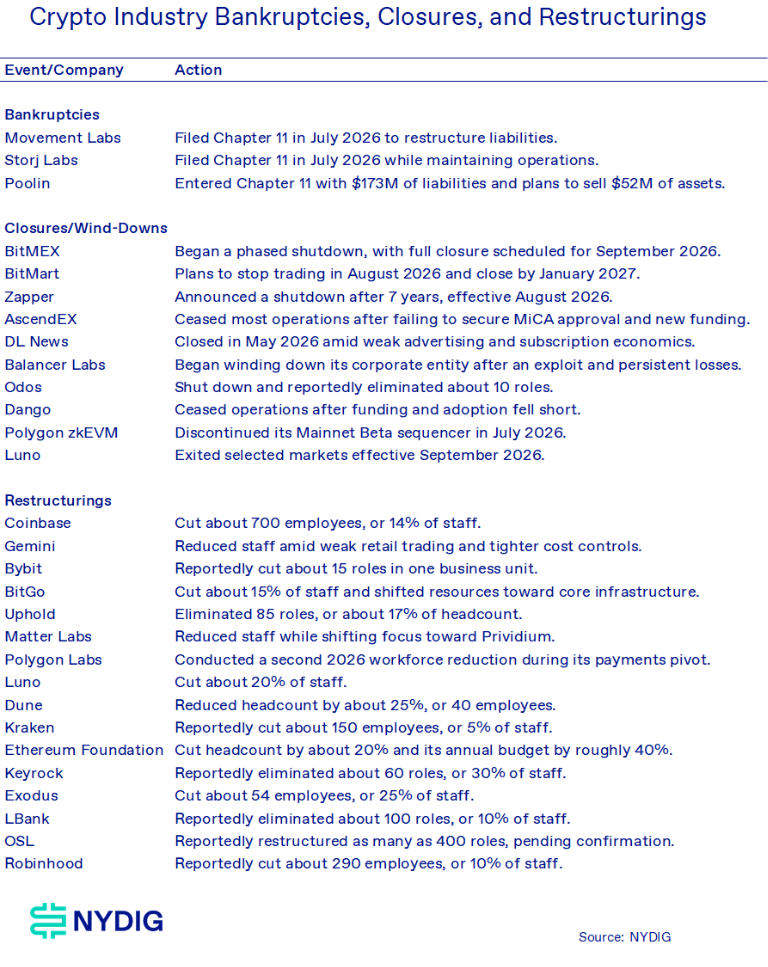
- BitMEX’s closure punctuates the broader contraction of the crypto industry, one that differs from the contraction last cycle.
- The closures reflect both cyclical and secular dynamics: business activity is tied to price, while the use case for blockchains has narrowed over time.
- Bitcoin and select digital assets and applications should continue to grow, even as credible blockchain use cases and industry profits concentrate.
Crypto Firms Going Gently into that Good Night
News came last week that BitMEX is shutting its doors. The announcement was notable because BitMEX was once the preeminent crypto derivatives exchange and helped define the market’s modern trading structure by inventing the perpetual swap, or “perp.” At its peak, BitMEX was where the industry’s most aggressive traders went to express equally aggressive views, often with extraordinary leverage.
The writing had been on the wall for years. BitMEX never fully recovered from Black Thursday in March 2020, when bitcoin fell roughly 50% intraday and cascading liquidations wiped out $1.7B of leverage positions that were only stopped when the exchange was knocked offline. Regulatory actions subsequently displaced the company’s founders, restricted its access to important markets and accelerated the migration of trading activity toward Binance, Bybit and other competitors. BitMEX remained an important piece of crypto history, but its economic relevance had faded long before the closure announcement.
BitMEX is not alone. Over the past several months, crypto exchanges, infrastructure providers, protocols and media companies have filed for bankruptcy, shut down products, reduced their workforces or explored sales. The following table summarizes the most notable actions.
A Different Kind of Drawdown
The current contraction looks different from the industry’s last major drawdown. The defining feature of 2022 was the spectacular implosion of highly interconnected institutions and digital assets, including Terra (LUNA)/TerraUSD (UST), Three Arrows Capital, Celsius, Voyager, BlockFi and FTX. Those failures produced billions of dollars of creditor losses, froze customer assets and exposed leverage that had been concealed by related-party transactions, inadequate controls and weak balance sheets. This cycle is quieter. Companies are generally not collapsing overnight under the weight of undisclosed liabilities and poor risk management practices.
Crypto Businesses Have Substantial Market Beta
Here’s a little secret about the business of crypto: there’s a lot of market beta to business activity. Trading volume, volatility, and on-chain activity are all positively correlated to price. Exchanges earn more when customers trade more. Market makers earn more when spreads and volumes expand. Wallets and data providers benefit when users interact with more protocols. Venture investors deploy more capital when exits remain available.
With price falling over 50% at its lowest point, it’s no wonder that many crypto businesses are struggling. Many businesses built their cost structures for $100K bitcoin with prices rising. $65K bitcoin and sideways price action is a very different business environment.


Crypto is not only about trading, but price appreciation remains its most powerful attractor. A major point of crypto, and arguably the dominant point for much of its investor base, is for the numbers attached to it to go up. Crypto is, to a significant degree, NGUT: Number Go Up Technology.
That may sound flippant, but it explains user behavior better than any formal valuation framework. Crypto isn’t an asset that’s bought on “value,” it’s one bought on momentum. Investors would rather buy bitcoin at $100K thinking it’s (shortly) going to $200K. They don’t want to buy it at $65K with the possibility of it falling to $40K (before going to $200K). Years of observing the behavior of institutional investors suggest similar behavior. Institutions may have investment committees, risk models and formal processes, but their flows remain heavily procyclical.
Bitcoin’s Use Case Narrows
Here’s the other thing about the cycle, something that was reinforced through numerous conversations at a recent conference: long-term supporters and builders quitting the industry altogether. Now, that’s been true for the history of crypto. The old guard, either having made their contribution, extracted their value, or failing to do either, cedes control to the new guard, who takes up the mantle to do the same. But this one feels different, and I’ll tell you why: crypto is losing the ability to dream. Said differently, the future states that crypto might occupy, affect, or supplant are becoming increasingly narrow.
Go back 15 years for a moment with me. Bitcoin was going to be for: machine-to-machine payments, micropayments, global remittances, a replacement for credit card payment networks, censorship-resistant electronic cash, and digital gold, and that’s just what I can remember off the top of my head. In short: Bitcoin was going to eat the world of payments. Here’s the thing: it hasn’t, at least not yet. That doesn’t mean that bitcoin and other digital assets haven’t had important roles. In fact, I’d argue that the store-of-value function (call it digital gold, a non-sovereign store of value, or neutral reserve asset) has been one huge trick, one much larger than anyone, including myself, might’ve guessed 15 years ago. I think if you asked people in 2011 what Bitcoin would be worth if it didn’t execute on the payments vision, you’d have probably guessed a lot less than the $2.5T that it recently peaked at.
Aside: at this conference, I was also asked “how do you pitch bitcoin?” To me, the easiest heuristic for institutional investors is still “digital gold.” That gets to the heart of how to value it (subjective), what it’s primarily used for (store of value), and how investors should allocate to it (set it and forget it).
The obvious pushback is that bitcoin does not always behave like gold. That was especially apparent in 2025, when gold surged and bitcoin did not. I am comfortable with that divergence. In fact, bitcoin’s low correlation with gold and limited sensitivity to macroeconomic variables are features, not flaws. Low R-squareds imply that most of bitcoin’s price variance is driven by idiosyncratic factors, which makes it more valuable to investors seeking genuine diversification.
I’m sympathetic to the frustration, though. If you expected bitcoin to behave like gold because of the moniker, it is understandable to be disappointed when it did not. Few things are more frustrating as an investor than getting the thesis right but the trade expression wrong.
The Great Blockchain Use-Case Compression
Bitcoin is not the only part of the digital-asset industry that has lost much of its forward-looking vision. Blockchains were once expected to transform identity, supply chains, land registries, music royalties, games, voting, and file storage. After 15 years of experimentation, however, the applications that have achieved meaningful adoption are overwhelmingly financial: bitcoin, stablecoins, decentralized finance, and tokenized real-world assets.
The reason is structural. For most non-financial applications, adding a blockchain introduces more friction than value. Decentralized systems are generally more expensive to operate, slower to process transactions, and less efficient at storing data than cloud-based alternatives. Those trade-offs are worthwhile only when an application requires censorship resistance, shared settlement, programmable ownership, or the removal of a trusted intermediary.
“Put it on a blockchain” was never a business model. It was a technology in search of a problem valuable enough to justify the added cost and complexity. Blockchains are best suited to recording ownership and transferring value, which explains why the surviving opportunity set is concentrated in money, trading, settlement, and asset ownership.
That narrower market is still economically significant because global financial assets and payments total hundreds of trillions of dollars. The problem is that the industry created thousands of digital assets, while the market may ultimately support only a handful of use cases.
Consolidation Should Continue
The current contraction is both cyclical and structural. The cyclical pressure is familiar: lower asset prices, weaker trading volumes, and reduced investor activity have compressed revenues across exchanges, lenders, market makers, data providers, and infrastructure companies. Businesses built around bull-market activity have been forced to cut costs, retrench, or close.
The structural pressure is more important. After 15 years of experimentation, the credible blockchain opportunity set has narrowed, while the remaining markets increasingly reward scale, liquidity, regulatory licenses, and distribution. Large exchanges can spread compliance and technology costs across millions of customers, major custodians can support institutions across multiple products, and established stablecoin issuers benefit from liquidity and network effects. Smaller competitors face many of the same fixed costs without comparable revenue.
The likely outcome is an industry with fewer exchanges, fewer general-purpose blockchains, fewer infrastructure providers, and fewer speculative applications. The surviving companies may ultimately be larger, more durable, and more profitable, but reaching that equilibrium will require additional closures, restructurings, and acquisitions. That may reverse during the next speculative upswing.
Investment Implications
Bitcoin was designed to reduce dependence on intermediaries, so building lasting businesses around it was always going to be difficult. The success of the asset does not guarantee the success of the companies surrounding it.
Bitcoin can appreciate while crypto businesses fail or consolidate. Stablecoins can expand even if issuance concentrates among a small number of providers. Tokenization can grow while economics accrue to only a handful of exchanges, custodians, issuers, and settlement platforms. The central investment question is not whether digital assets will persist, but where profits will concentrate.
For those still building and still dreaming, however, a few words to live by:
Do not go gentle into that good night.
Rage, rage against the dying of the light.