
UX Design & Webflow Agency NYC | Composite Global
All Posts

Historical Parallels: The 2022 Cycle and Today’s Drawdown

Share

Greg Cipolaro

March 13, 2026

PDF
Download the full letter to print or read anytime
Download
PDF
Download the full letter to print or read anytime
Download

IN TODAY'S ISSUE:

  • Comparing the 2021 - 2022 cycle versus the current drawdown.
  • The growing TAM for unmined bitcoins?
  • Implications as crypto transitions from an alternative financial system to one embedded in TradFi.

A Look Back at the 2021 - 2022 Drawdown and Comparisons to Today

Past crypto cycles are top of mind right now. First, it is the sixth anniversary of one of, if not the worst, liquidation/sell-off events in crypto history: Black Thursday, March 12, 2020. If you didn’t experience it, or did and just want to experience some PTSD, Coin Metrics published excellent write-ups on the event (here and here). The summary of the event is that the onset of the COVID-19 health care and economic crisis rippled through markets, causing a 40% decline in the price of bitcoin, which didn’t end until BitMEX, the dominant derivatives exchange at the time, was (fortunately?) knocked offline by a DDoS attack.

Second, there was the recent lawsuit in which the administrator of the Terraform Labs bankruptcy, the company behind the ill-fated Terra (LUNA) and TerraUSD (UST) token and algorithmic stablecoin ecosystem, sued trading firm Jane Street, alleging it helped trigger the collapse of those tokens. The failure of LUNA/UST evaporated roughly $60 billion in crypto wealth, on par with the collapse of Lehman Brothers, becoming a primary catalyst behind the broader market meltdown in 2022.

The case prompted a surprising number of questions. While we have already spilled plenty of ink criticizing the LUNA/UST design in the past, and the courts will ultimately decide the merits of the lawsuit, it brought back events of that year and how the current drawdown is unfolding. There are several important lessons from that episode that may still help guide investors today.
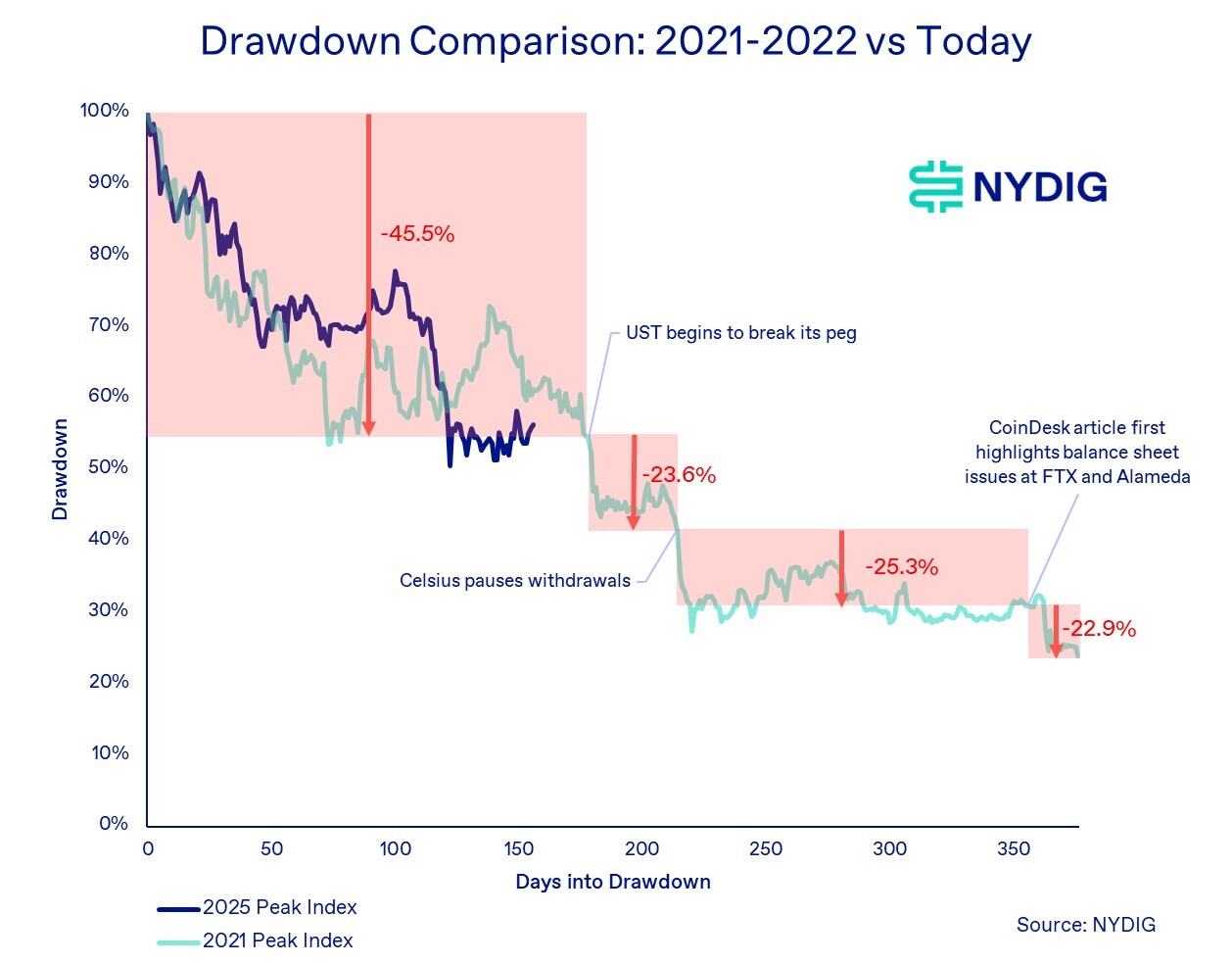
First Part of the 2021 Drawdown

The first observation is that the initial drawdown, following bitcoin’s $69K peak in November 2021, just ahead of the launch of the ProShares Bitcoin ETF (BITO), largely reflected profit-taking rather than structural stress. The launch of BITO clearly helped propel bitcoin to a new all-time high. Front-month CME basis briefly rose above 35%, highlighting the extent of speculative demand at the time.

From that peak, bitcoin fell roughly 45.5%, which in hindsight was a fairly typical correction following a cycle top. During this period, there were a couple of notable incidents, most prominently the Wormhole and Ronin bridge hacks in February and March 2022, which together totaled about $950 million. Trading volumes were declining, collateral values were falling, and questionable lending and business practices were already underway across parts of the ecosystem. But importantly, no core market infrastructure had broken yet.

Structural Collapse Followed in 2022

What followed in 2022 was a cascade of failures across crypto market infrastructure, beginning with the rapid collapse of LUNA/UST in early May 2022. At the time, LUNA was the 6th largest non-stablecoin cryptocurrency, while UST was the 3rd largest stablecoin and the 10th largest crypto asset overall (historical snapshots on CoinMarketCap are always fun). At their peak, the two accounted for roughly $60 billion in combined market value.

After UST first “broke the buck,” bitcoin fell another 23.6%. The next shock came with the unraveling of the crypto lending sector, beginning with Celsius pausing withdrawals in June 2022. Bitcoin subsequently declined another 25.3%, then traded sideways for a period as markets digested the fallout from additional failures, including Voyager and Three Arrows Capital.

The final leg lower, another 22.9% drawdown, came after reports of balance sheet issues at FTX in early November, which ultimately triggered the exchange’s collapse and marked the last major phase of the 2022 downturn before the market eventually bottomed.

Today: A Familiar First Phase, But Damage Could Be Limited

The early phase of the drawdown following the 2021 peak looks very similar to where we find ourselves today, a roughly 52.5% decline from the cycle high of $126K on October 6 to a low of $60K on February 6. While prices have fallen sharply, there has been little evidence of systemic breakage. Aside from the failure of Blockfills, which left a relatively small $75 million hole in its balance sheet by industry standards, the core infrastructure of the market has largely remained intact.
That’s why we continue to watch closely for incidental damage across the ecosystem. So far, however, there has been little sign of broader systemic stress surfacing beyond the Blockfills situation.

If additional pressure fails to materialize, this drawdown could ultimately prove less severe than the 2021 - 2022 downturn. The comparison isn’t perfect, however. Previous cycle drawdowns occurred even without widespread infrastructure failures. That said, business practices across the industry appear more disciplined this time around, which could help limit the risk of cascading failures if conditions deteriorate further.

Bitcoin’s Shrinking Available Supply, but Growing TAM?

This week marked the mining of Bitcoin’s 20 millionth coin. With that milestone, only 1 million bitcoins remain to be created, which will be issued gradually over the next 114 years. While it took just over 17 years for the network to produce the first 20 million coins, the remaining 1 million will not be fully mined until around the year 2140, reflecting Bitcoin’s steadily declining issuance schedule.

What’s interesting about this dynamic is that even as the number of coins left to be mined steadily declines, the dollar value of that remaining supply, measured as the remaining coins multiplied by the current bitcoin price at the time, has continued to rise over time. That outcome is somewhat counterintuitive given the shrinking supply of future issuance.

To be clear, we wouldn’t read too much into this, as the metric largely tracks bitcoin’s price. Still, it is not necessarily what one might expect at first glance, particularly as many bitcoin miners are increasingly diversifying into secularly growing compute-intensive industries such as HPC and AI. Nonetheless, it is an interesting way to frame the economics of the remaining supply.

Crypto’s Next Phase is About TradFi Integration

Crypto is increasingly shifting from an alternative financial system to one that is embedded within traditional financial infrastructure, with several recent developments illustrating this transition. Kraken’s banking arm received a limited Federal Reserve master account, Nasdaq announced a partnership with Kraken to develop tokenized equities, and Intercontinental Exchange (ICE), parent of the NYSE which is developing its own tokenized securities platform, made a strategic investment in OKX as part of a broader effort to integrate on-chain infrastructure with traditional trading, custody, and settlement systems. Taken together, these items suggest that crypto is rapidly integrating with the core plumbing of capital markets rather than operating alongside it.

Stablecoins and Payments Expanding Rapidly

The same dynamic is unfolding in payments and stablecoins just as rapidly. Stripe, Circle, PayPal, Visa, and Mastercard are all building infrastructure that integrates stablecoins into existing merchant and settlement networks. In most cases, stablecoins are not replacing traditional payment systems but instead becoming a new settlement layer beneath them, enabling faster cross-border transfers, programmable payments, and globally interoperable liquidity.

Stripe is integrating stablecoins into checkout, subscriptions, and billing APIs, while also developing its own blockchain payment infrastructure, Tempo, designed to support multi-chain stablecoin settlement and programmable payments directly within its merchant platform. Circle is expanding beyond issuing USDC by building dedicated infrastructure for financial institutions, including the Circle Payments Network (CPN) and its Arc blockchain, which are designed to facilitate bank and fintech settlement using stablecoins.

Meanwhile, PayPal has embedded its PYUSD stablecoin into its wallet and merchant ecosystem, allowing users to send, hold, and transact with stablecoins within PayPal and Venmo. At the network level, Visa and Mastercard are enabling issuers and payment partners to settle transactions on-chain across multiple blockchains, effectively integrating stablecoins into the global card infrastructure. Together, these initiatives suggest that the largest payments companies are not just supporting stablecoins as assets but are increasingly building the blockchain infrastructure themselves, reinforcing the trend of crypto rails becoming embedded within traditional financial networks.

Other fintech platforms are beginning to move in the same direction. Block (Square/Cash App) CEO Jack Dorsey, long focused on bitcoin infrastructure, has recently indicated that merchant demand for stablecoins is increasing. Meanwhile, fintech platforms such as Klarna and SoFi are exploring their own stablecoins or blockchain settlement systems, suggesting that tokenized dollars may increasingly become a standard component of modern financial infrastructure, rather than a niche crypto product.

Integration, not Substitution

For institutional investors, the implication is that the opportunity is shifting away from purely speculative crypto assets toward the interfaces between digital asset rails and traditional finance: tokenized securities markets, stablecoin payment infrastructure, and software platforms that enable machine-to-machine commerce. Crypto’s first phase built an alternative system; the next phase is about integration, as blockchain-based settlement gradually becomes part of the financial system’s underlying infrastructure.

Implications for Investors

For institutional investors, the opportunity in digital assets is increasingly shifting to the infrastructure that connects blockchain-based settlement with traditional financial markets. Some of that is happening on open permissionless Dapp platforms, such as Ethereum and Solana, but much of it is happening on private or permissioned blockchains and infrastructure. This suggests that long-term investment opportunities may concentrate in a smaller set of assets, including select tokens that capture value through transaction fees or have significant asset issuance on their platforms, as well as centralized organizations building and operating core infrastructure. As a result, the investable universe in crypto may narrow over time, a trend we have previously highlighted, reflected in bitcoin’s growing market dominance and the relative absence of a broad altcoin cycle in the last market cycle.

Market Update
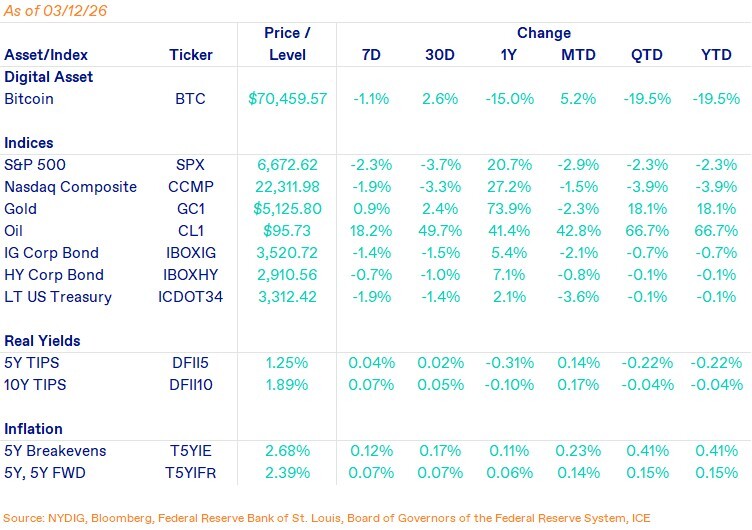
Bitcoin traded lower through the first half of the week before recovering in the back half, finishing the period down 1.1% on the week but still up 5.2% month-to-date. While no clear fundamental catalysts were driving the rebound, the price action suggests that the wave of marginal sellers that pressured the price to $60K in early February may be largely exhausted.

Derivatives markets also point to stabilization. CME futures basis has continued to firm modestly, while perpetual swap funding rates remain slightly negative. Together with offshore futures open interest holding broadly flat in bitcoin terms, this suggests positioning remains cautious and that the recent rally has not been driven by aggressive long leverage.

Flows and liquidity conditions across the broader crypto ecosystem remain constructive. Bitcoin ETFs saw steady but relatively small inflows during the trading week. Total stablecoin balances continue to rebound, driven primarily by growth in USDC, with USDT beginning to show early signs of growth as well after a period of stabilization.

Macro conditions remain mixed. Gold rose modestly on the week, while oil prices remain elevated at $95, even after pulling back from the recent spike near $120 amid the ongoing conflict in Iran. Energy markets continue to signal geopolitical risk and potential inflation pressures. Meanwhile, U.S. equities declined and real yields moved modestly higher, creating a somewhat less supportive backdrop for risk assets broadly.

Important News This Week

Investing:

Bitcoin's Mined Supply Hits 20 Million Milestone, Leaving Final 1 Million BTC To Be Issued Over Next 114 Years - The Block

Regulation and Taxation:

SEC, CFTC End Years of Rivalry with Deal That Will Mean Combined Crypto Oversight - CoinDesk

Wall Street Banks Weigh Lawsuit Over Crypto Banking Charters - Decrypt

Companies:

Strive Announces SATA Enhancements and Purchase of Bitcoin - Strive

Binance, PayPal, And Ripple Join Mastercard’s Massive New Push into Blockchain Payments - CoinDesk

Asia’s Biggest Bitcoin Buyer Now Wants to Build the BTC Ecosystem - CoinDesk

Tether Announces Strategic Investment in Ark Labs, Reintroducing Stablecoins to Programmable Bitcoin Infrastructure - Tether

Utexo Raises $7.5M Led by Tether to Launch Native USDT Settlements on Bitcoin - Chainwire

Bitcoin Die-Hard Jack Dorsey Doesn't Like Stablecoins, But Block Will Use Them Anyway - Decrypt

Stablecoin Firms Bet Big on AI Agent Payments That Barely Exist - Bloomberg

Nasdaq Partners with Kraken Parent Payward to Link Tokenized Equities with Defi Networks - The Block

Inside the Binance Accounts Internal Investigators Say Helped Transfer More Than $1 Billion To Iran-Linked Entities - Fortune

Upcoming Events

Mar 18 - FOMC interest rate decision
Mar 27 -
CME expiry
Apr 27 -
Bitcoin 2026 conference

Start Reading
Start Reading

IN TODAY'S ISSUE:

  • Comparing the 2021 - 2022 cycle versus the current drawdown.
  • The growing TAM for unmined bitcoins?
  • Implications as crypto transitions from an alternative financial system to one embedded in TradFi.

A Look Back at the 2021 - 2022 Drawdown and Comparisons to Today

Past crypto cycles are top of mind right now. First, it is the sixth anniversary of one of, if not the worst, liquidation/sell-off events in crypto history: Black Thursday, March 12, 2020. If you didn’t experience it, or did and just want to experience some PTSD, Coin Metrics published excellent write-ups on the event (here and here). The summary of the event is that the onset of the COVID-19 health care and economic crisis rippled through markets, causing a 40% decline in the price of bitcoin, which didn’t end until BitMEX, the dominant derivatives exchange at the time, was (fortunately?) knocked offline by a DDoS attack.

Second, there was the recent lawsuit in which the administrator of the Terraform Labs bankruptcy, the company behind the ill-fated Terra (LUNA) and TerraUSD (UST) token and algorithmic stablecoin ecosystem, sued trading firm Jane Street, alleging it helped trigger the collapse of those tokens. The failure of LUNA/UST evaporated roughly $60 billion in crypto wealth, on par with the collapse of Lehman Brothers, becoming a primary catalyst behind the broader market meltdown in 2022.

The case prompted a surprising number of questions. While we have already spilled plenty of ink criticizing the LUNA/UST design in the past, and the courts will ultimately decide the merits of the lawsuit, it brought back events of that year and how the current drawdown is unfolding. There are several important lessons from that episode that may still help guide investors today.

First Part of the 2021 Drawdown

The first observation is that the initial drawdown, following bitcoin’s $69K peak in November 2021, just ahead of the launch of the ProShares Bitcoin ETF (BITO), largely reflected profit-taking rather than structural stress. The launch of BITO clearly helped propel bitcoin to a new all-time high. Front-month CME basis briefly rose above 35%, highlighting the extent of speculative demand at the time.

From that peak, bitcoin fell roughly 45.5%, which in hindsight was a fairly typical correction following a cycle top. During this period, there were a couple of notable incidents, most prominently the Wormhole and Ronin bridge hacks in February and March 2022, which together totaled about $950 million. Trading volumes were declining, collateral values were falling, and questionable lending and business practices were already underway across parts of the ecosystem. But importantly, no core market infrastructure had broken yet.

Structural Collapse Followed in 2022

What followed in 2022 was a cascade of failures across crypto market infrastructure, beginning with the rapid collapse of LUNA/UST in early May 2022. At the time, LUNA was the 6th largest non-stablecoin cryptocurrency, while UST was the 3rd largest stablecoin and the 10th largest crypto asset overall (historical snapshots on CoinMarketCap are always fun). At their peak, the two accounted for roughly $60 billion in combined market value.

After UST first “broke the buck,” bitcoin fell another 23.6%. The next shock came with the unraveling of the crypto lending sector, beginning with Celsius pausing withdrawals in June 2022. Bitcoin subsequently declined another 25.3%, then traded sideways for a period as markets digested the fallout from additional failures, including Voyager and Three Arrows Capital.

The final leg lower, another 22.9% drawdown, came after reports of balance sheet issues at FTX in early November, which ultimately triggered the exchange’s collapse and marked the last major phase of the 2022 downturn before the market eventually bottomed.

Today: A Familiar First Phase, But Damage Could Be Limited

The early phase of the drawdown following the 2021 peak looks very similar to where we find ourselves today, a roughly 52.5% decline from the cycle high of $126K on October 6 to a low of $60K on February 6. While prices have fallen sharply, there has been little evidence of systemic breakage. Aside from the failure of Blockfills, which left a relatively small $75 million hole in its balance sheet by industry standards, the core infrastructure of the market has largely remained intact.
That’s why we continue to watch closely for incidental damage across the ecosystem. So far, however, there has been little sign of broader systemic stress surfacing beyond the Blockfills situation.

If additional pressure fails to materialize, this drawdown could ultimately prove less severe than the 2021 - 2022 downturn. The comparison isn’t perfect, however. Previous cycle drawdowns occurred even without widespread infrastructure failures. That said, business practices across the industry appear more disciplined this time around, which could help limit the risk of cascading failures if conditions deteriorate further.

Bitcoin’s Shrinking Available Supply, but Growing TAM?

This week marked the mining of Bitcoin’s 20 millionth coin. With that milestone, only 1 million bitcoins remain to be created, which will be issued gradually over the next 114 years. While it took just over 17 years for the network to produce the first 20 million coins, the remaining 1 million will not be fully mined until around the year 2140, reflecting Bitcoin’s steadily declining issuance schedule.

What’s interesting about this dynamic is that even as the number of coins left to be mined steadily declines, the dollar value of that remaining supply, measured as the remaining coins multiplied by the current bitcoin price at the time, has continued to rise over time. That outcome is somewhat counterintuitive given the shrinking supply of future issuance.

To be clear, we wouldn’t read too much into this, as the metric largely tracks bitcoin’s price. Still, it is not necessarily what one might expect at first glance, particularly as many bitcoin miners are increasingly diversifying into secularly growing compute-intensive industries such as HPC and AI. Nonetheless, it is an interesting way to frame the economics of the remaining supply.

Crypto’s Next Phase is About TradFi Integration

Crypto is increasingly shifting from an alternative financial system to one that is embedded within traditional financial infrastructure, with several recent developments illustrating this transition. Kraken’s banking arm received a limited Federal Reserve master account, Nasdaq announced a partnership with Kraken to develop tokenized equities, and Intercontinental Exchange (ICE), parent of the NYSE which is developing its own tokenized securities platform, made a strategic investment in OKX as part of a broader effort to integrate on-chain infrastructure with traditional trading, custody, and settlement systems. Taken together, these items suggest that crypto is rapidly integrating with the core plumbing of capital markets rather than operating alongside it.

Stablecoins and Payments Expanding Rapidly

The same dynamic is unfolding in payments and stablecoins just as rapidly. Stripe, Circle, PayPal, Visa, and Mastercard are all building infrastructure that integrates stablecoins into existing merchant and settlement networks. In most cases, stablecoins are not replacing traditional payment systems but instead becoming a new settlement layer beneath them, enabling faster cross-border transfers, programmable payments, and globally interoperable liquidity.

Stripe is integrating stablecoins into checkout, subscriptions, and billing APIs, while also developing its own blockchain payment infrastructure, Tempo, designed to support multi-chain stablecoin settlement and programmable payments directly within its merchant platform. Circle is expanding beyond issuing USDC by building dedicated infrastructure for financial institutions, including the Circle Payments Network (CPN) and its Arc blockchain, which are designed to facilitate bank and fintech settlement using stablecoins.

Meanwhile, PayPal has embedded its PYUSD stablecoin into its wallet and merchant ecosystem, allowing users to send, hold, and transact with stablecoins within PayPal and Venmo. At the network level, Visa and Mastercard are enabling issuers and payment partners to settle transactions on-chain across multiple blockchains, effectively integrating stablecoins into the global card infrastructure. Together, these initiatives suggest that the largest payments companies are not just supporting stablecoins as assets but are increasingly building the blockchain infrastructure themselves, reinforcing the trend of crypto rails becoming embedded within traditional financial networks.

Other fintech platforms are beginning to move in the same direction. Block (Square/Cash App) CEO Jack Dorsey, long focused on bitcoin infrastructure, has recently indicated that merchant demand for stablecoins is increasing. Meanwhile, fintech platforms such as Klarna and SoFi are exploring their own stablecoins or blockchain settlement systems, suggesting that tokenized dollars may increasingly become a standard component of modern financial infrastructure, rather than a niche crypto product.

Integration, not Substitution

For institutional investors, the implication is that the opportunity is shifting away from purely speculative crypto assets toward the interfaces between digital asset rails and traditional finance: tokenized securities markets, stablecoin payment infrastructure, and software platforms that enable machine-to-machine commerce. Crypto’s first phase built an alternative system; the next phase is about integration, as blockchain-based settlement gradually becomes part of the financial system’s underlying infrastructure.

Implications for Investors

For institutional investors, the opportunity in digital assets is increasingly shifting to the infrastructure that connects blockchain-based settlement with traditional financial markets. Some of that is happening on open permissionless Dapp platforms, such as Ethereum and Solana, but much of it is happening on private or permissioned blockchains and infrastructure. This suggests that long-term investment opportunities may concentrate in a smaller set of assets, including select tokens that capture value through transaction fees or have significant asset issuance on their platforms, as well as centralized organizations building and operating core infrastructure. As a result, the investable universe in crypto may narrow over time, a trend we have previously highlighted, reflected in bitcoin’s growing market dominance and the relative absence of a broad altcoin cycle in the last market cycle.

Market Update

Bitcoin traded lower through the first half of the week before recovering in the back half, finishing the period down 1.1% on the week but still up 5.2% month-to-date. While no clear fundamental catalysts were driving the rebound, the price action suggests that the wave of marginal sellers that pressured the price to $60K in early February may be largely exhausted.

Derivatives markets also point to stabilization. CME futures basis has continued to firm modestly, while perpetual swap funding rates remain slightly negative. Together with offshore futures open interest holding broadly flat in bitcoin terms, this suggests positioning remains cautious and that the recent rally has not been driven by aggressive long leverage.

Flows and liquidity conditions across the broader crypto ecosystem remain constructive. Bitcoin ETFs saw steady but relatively small inflows during the trading week. Total stablecoin balances continue to rebound, driven primarily by growth in USDC, with USDT beginning to show early signs of growth as well after a period of stabilization.

Macro conditions remain mixed. Gold rose modestly on the week, while oil prices remain elevated at $95, even after pulling back from the recent spike near $120 amid the ongoing conflict in Iran. Energy markets continue to signal geopolitical risk and potential inflation pressures. Meanwhile, U.S. equities declined and real yields moved modestly higher, creating a somewhat less supportive backdrop for risk assets broadly.

Important News This Week

Investing:

Bitcoin's Mined Supply Hits 20 Million Milestone, Leaving Final 1 Million BTC To Be Issued Over Next 114 Years - The Block

Regulation and Taxation:

SEC, CFTC End Years of Rivalry with Deal That Will Mean Combined Crypto Oversight - CoinDesk

Wall Street Banks Weigh Lawsuit Over Crypto Banking Charters - Decrypt

Companies:

Strive Announces SATA Enhancements and Purchase of Bitcoin - Strive

Binance, PayPal, And Ripple Join Mastercard’s Massive New Push into Blockchain Payments - CoinDesk

Asia’s Biggest Bitcoin Buyer Now Wants to Build the BTC Ecosystem - CoinDesk

Tether Announces Strategic Investment in Ark Labs, Reintroducing Stablecoins to Programmable Bitcoin Infrastructure - Tether

Utexo Raises $7.5M Led by Tether to Launch Native USDT Settlements on Bitcoin - Chainwire

Bitcoin Die-Hard Jack Dorsey Doesn't Like Stablecoins, But Block Will Use Them Anyway - Decrypt

Stablecoin Firms Bet Big on AI Agent Payments That Barely Exist - Bloomberg

Nasdaq Partners with Kraken Parent Payward to Link Tokenized Equities with Defi Networks - The Block

Inside the Binance Accounts Internal Investigators Say Helped Transfer More Than $1 Billion To Iran-Linked Entities - Fortune

Upcoming Events

Mar 18 - FOMC interest rate decision
Mar 27 -
CME expiry
Apr 27 -
Bitcoin 2026 conference

Start Reading
Start Reading

This report has been prepared solely for informational purposes and does not represent investment advice or provide an opinion regarding the fairness of any transaction to any and all parties nor does it constitute an offer, solicitation or a recommendation to buy or sell any particular security or instrument or to adopt any investment strategy. Charts and graphs provided herein are for illustrative purposes only. This report does not represent valuation judgments with respect to any financial instrument, issuer, security or sector that may be described or referenced herein and does not represent a formal or official view of New York Digital Investment Group or its affiliates (collectively NYDIG).It should not be assumed that NYDIG will make investment recommendations in the future that are consistent with the views expressed herein, or use any or all of the techniques or methods of analysis described herein. NYDIG may have positions (long or short) or engage in securities transactions that are not consistent with the information and views expressed in this report. The information provided herein is valid only for the purpose stated herein and as of the date hereof (or such other date as may be indicated herein) and no undertaking has been made to update the information, which may be superseded by subsequent market events or for other reasons. The information in this report may contain forward-looking statements regarding future events, targets or expectations. NYDIG neither assumes any duty to nor undertakes to update any forward-looking statements. There is no assurance that any forward-looking events or targets will be achieved, and actual outcomes may be significantly different from those shown herein. The information in this report, including statements concerning financial market trends, is based on current market conditions, which will fluctuate and may be superseded by subsequent market events or for other reasons. Information furnished by others, upon which all or portions of this report are based, are from sources believed to be reliable. However, NYDIG makes no representation as to the accuracy, adequacy or completeness of such information and has accepted the information without further verification. No warranty is given as to the accuracy, adequacy or completeness of such information. No responsibility is taken for changes in market conditions or laws or regulations and no obligation is assumed to revise this report to reflect changes, events or conditions that occur subsequent to the date hereof. Nothing contained herein constitutes investment, legal, tax or other advice nor is it to be relied on in making an investment or other decision. Legal advice can only be provided by legal counsel. NYDIG shall have no liability to any third party in respect of this report or any actions taken or decisions made as a consequence of the information set forth herein. By accessing this report, the recipient acknowledges its understanding and acceptance of the foregoing terms.

newsletter

Sign up for weekly research

Subscribe now to learn what’s driving bitcoin markets, track significant regulatory developments, and get the data that deserves your attention.

Featured Research & Insights

Historical Parallels: The 2022 Cycle and Today’s Drawdown

Historical Parallels: The 2022 Cycle and Today’s Drawdown

Historical Parallels: The 2022 Cycle and Today’s Drawdown
Research
March 13, 2026
Read Now
AI Market Anxiety

AI Market Anxiety

AI Market Anxiety
Video
March 11, 2026
Bitcoin, Not Software Stocks

Bitcoin, Not Software Stocks

Bitcoin, Not Software Stocks
Research
March 6, 2026
Read Now
Let's Connect

Want to learn more about NYDIG?

Please complete the contact form, and we will help you find the right person to learn more.