


IN TODAY'S ISSUE:
- Bitcoin clears $76K on thinning supply and net-positive ETF flows, with positioning data still far from crowded.
- As institutional heavyweights continue to embrace Bitcoin, distribution will likely determine who wins.
- Strategy has raised $3.4B via STRC year-to-date, with recent volume suggesting the ATM is running hot again.
Bitcoin Battles Back
Bitcoin has moved through $76K, pushing beyond the upper bound of the $75K to $76K range that has defined market resistance in recent weeks. A sustained hold above it would signal a transition toward a higher trading regime, with potential upside toward $90K to $100K. A failure to hold would likely pull the market back into consolidation mode.
Market internals remain balanced. Since March 30, ETF flows have been uneven but net positive at approximately $1.2 billion, providing a consistent source of demand. MSTR’s STRC (see section) has also been a significant driver of bitcoin demand as well. This has been met by supply from whales and shorter-term holders monetizing strength. The result has been a gradual upward grind rather than a decisive breakout, although recent price action suggests that supply may be thinning at current levels.
The macro backdrop has improved as well. With the temporary cease-fire in Iran, the Strait of Hormuz is (presently) open, reducing the probability of a material disruption to global energy flows. This has supported a broader risk-on environment across asset classes. Equities have advanced to new highs, reflecting a combination of easing geopolitical concerns and resilient liquidity conditions. Bitcoin has benefited from this shift as well.
Cross-asset signals indicate partial decoupling. Correlation with US equities and tech stocks is on the rise, but correlation with software stocks (IGV) is declining. Positioning metrics also point to a market that is not extended. Perpetual funding rates remain negative, and CME basis is subdued, suggesting that directional exposure is still measured rather than crowded.
The implication is that this move is not driven by speculative excess. It reflects a market transitioning from recovery into a potential expansion phase, supported by steady institutional demand, improving macro conditions, and relatively conservative positioning. The durability of the breakout will depend on the market’s ability to establish acceptance above $76K.
From Exposure to Integration: Bitcoin Becomes a Portfolio Building Block
Institutions are continuing to build around bitcoin, moving beyond simple spot exposure and into a more complete product ecosystem. Morgan Stanley’s recent ETF launch is a clear extension of that trend. While its 14 bps fee undercuts incumbents like IBIT and FBTC, its real edge is distribution. With over $7 trillion across its wealth platform, Morgan Stanley can internalize demand and scale quickly, embedding bitcoin exposure directly into client portfolios. Early traction, around $120 million in AUM, shows how fast flows follow when distribution is in place.
At the same time, Goldman Sachs and BlackRock are pushing into the next layer by pairing bitcoin exposure with yield. Demand is growing from investors who want bitcoin in portfolios but also need income, not just volatility. This is not a new concept. Products like YBIT, BPI, and YBTC proved it, but adoption has been limited. What has been missing is an institutional-grade version that is scalable and portfolio-friendly.
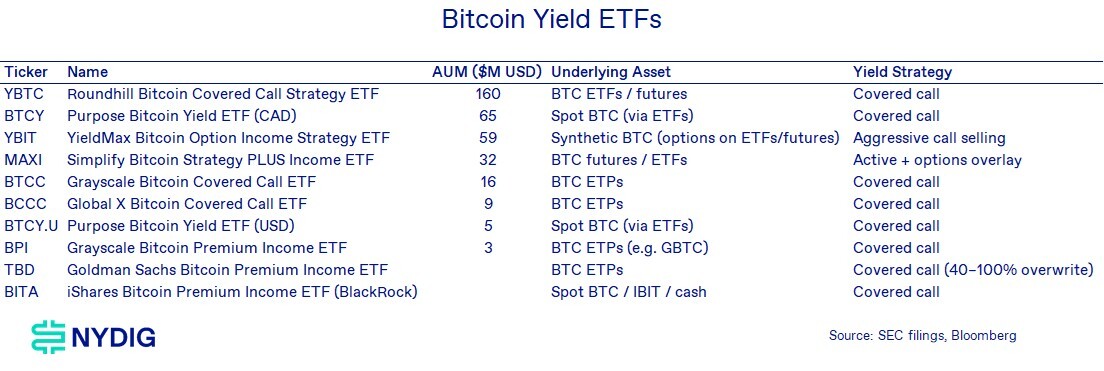
Both new funds run the same core strategy: long bitcoin exposure with a call-writing overlay to generate monthly income. The tradeoff, capped upside in exchange for premium, is identical. The differences are structural. Goldman’s fund is a ’40 Act RIC issuing 1099s. BlackRock is a partnership structure with K-1s, which screens out much institutional capital. Portfolio construction is also somewhat similar. BlackRock has more flexibility with also the ability to own the underlying bitcoin, but both will likely rely on bitcoin ETPs as the underlying. Goldman specifies a 40 to 100 percent overwrite range, giving managers defined flexibility, while BlackRock leaves it open-ended.
Despite these nuances, the core outcome is unchanged. Both strategies trade upside for income and will lag in strong bull markets.
Our opinion is that the institutionalization of bitcoin will not be about inventing new products, but industrializing ones that already work for traditional assets. Fees, liquidity, operational strength, and especially distribution will be the most important factors. As that framing takes hold, it becomes easier for institutions to underwrite, allocate, and scale, expanding the addressable market more than any single product launch.
STRC Activity Signals Continued Bitcoin Accumulation for MSTR
Once again, STRC has been at the center of market attention this week. Strategy has already raised roughly $3.4 billion year to date through STRC issuance to fund bitcoin purchases, and recent trading activity suggests that pace has accelerated.
Volumes on Monday and Tuesday stood out, with $2.8 billion in STRC traded across the two sessions and back-to-back record highs. That level of turnover typically points to primary issuance moving through the market, particularly when the security is trading at or near par. Strategy does not issue STRC continuously. It taps STRC opportunistically when pricing is supportive, and high volume at par is often the clearest indication that the ATM is active. Tracking volume alongside price has become one of the more reliable ways to gauge when capital is being raised.

The trading activity brings up balance sheet considerations. Historically, the cash interest payment obligations on its convertible notes and preferred equity, including STRC, were well covered by Strategy’s cash reserves, recently representing roughly two years of interest payment coverage. Following this week’s activity, that buffer is unclear. If the full $2.8 billion in recent STRC volume translated into issuance used primarily for bitcoin purchases without a corresponding increase in cash reserves, coverage could fall. That does not imply immediate stress, and there’s no contractual obligation to set aside the cash reserves, plus MSTR has billions in bitcoin, but it does reduce flexibility and increase sensitivity to future funding conditions.
Market Update
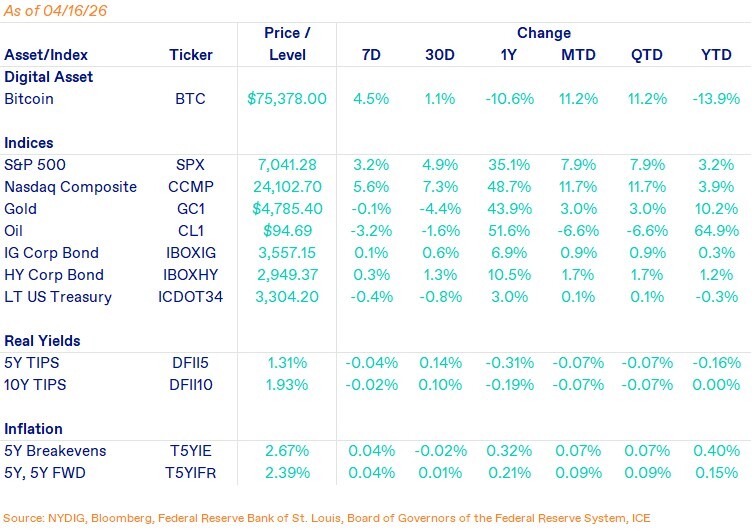
Bitcoin advanced 4.5% over the past week, outperforming most major asset classes and extending its recent recovery into the mid-$70K range. The move stands out against a generally constructive but more measured backdrop in traditional markets, with the S&P 500 up 3.2% and the Nasdaq gaining 5.6% over the same period.
Within macro assets, performance was mixed. Gold was essentially flat on the week, while oil declined 3.2%, reflecting some easing in geopolitical risk premia. Credit markets were stable, with both investment grade and high yield posting modest gains. Rates moved slightly lower, with long-duration Treasuries up on the week, while real yields edged down marginally.
Against this backdrop, bitcoin’s relative strength suggests continued incremental demand, supported by both improving risk sentiment and asset-specific flows. The magnitude of the move, while constructive, remains consistent with a grind higher rather than a disorderly rally, aligning with broader indications of still-cautious positioning.
Important News This Week
Companies & Industry:
Strive Increases Dividend Rate on Preferred Stock SATA to 13% - Yahoo! Finance
Drift Protocol Hack: How Privileged Access Led to a $285M Loss - Chainalysis
EToro to Acquire Crypto Wallet Startup Zengo in $70 Million Deal - Bloomberg
Trump-Backed WLFI Moves to Unlock 62 Billion Tokens After $75 Million Loan Controversy - CoinDesk
Trump-Linked World Liberty Project Faces Investor Revolt - Bloomberg
Investing:
Charles Schwab to Launch Direct Bitcoin, Ether Trading to Compete with Robinhood - CNBC
Upcoming Events
Apr 24 - CME expiry
Apr 27 - Bitcoin 2026 conference in Las Vegas
Apr 29 - FOMC interest rate decision
May 12 - CPI inflation data release