


IN TODAY'S ISSUE:
- We outline key takeaways from Bitcoin 2026 in Las Vegas, where focus areas concentrated on digital credit, lending markets, AI, and quantum computing.
- Conference sentiment moderated year-over-year, but meeting quality and engagement levels remained high.
- Institutional development continued without slowdown despite softer sentiment, reinforcing that capital formation and product buildout remain active across cycles.
Viva Las Vegas
We’re back from the Bitcoin 2026 conference in Vegas, the largest gathering of its kind. Although we’re poorly rested, we wanted to relay our high-level thoughts about the event, including key takeaways from our participation on panels, observations from the broader events, and key focus items from our meetings and conversations with institutions in the ecosystem.
Cyclical Reset Is Driving Sentiment
Let’s get this out of the way first – the vibe was subdued this year, especially in comparison to 2025. As a reminder, at this time in 2025, the current administration was newly in power, regulatory changes were underway, the strategic bitcoin reserve had just been created, ETFs were humming along, DATs had just appeared on the scene in a big way, and bitcoin was on its way to an all-time high. By contrast, this year much of the administration’s promises have been or are on the verge of being accomplished, price has undergone a precipitous drop from the all-time high but has rebounded and now stabilized, volatility is down, a conflict with Iran is underway with no discernible time frame, and twin techno fears of AI and quantum computing are on every investor's lips. But even though sentiment was down, participants were not out.
Institutional Build Continues Beneath the Surface
Despite weaker sentiment, the quality of meetings with financial institutions, corporates, and investors was as high as ever. Bitcoin is shifting from a predominantly portfolio allocation decision toward a core component of financial infrastructure, as evidenced by increasing integration across custody, trading, and credit markets. This shift is evident in bitcoin’s growing use as collateral for margin, secured lending, and structured products, indicating a transition toward financialization rather than purely directional speculation.
Credit and Lending Are Emerging as Core Growth Vectors
One of the biggest themes was the evolution of digital asset credit markets, where activities are moving beyond simple overcollateralized loans toward hybrid instruments such as preferred equity offerings, including STRC from Strategy (MSTR) and SATA from Strive (ASST), products designed to meet investor yield targets driven by bitcoin returns. The products remain niche in the broader credit landscape, with just 2 products, but they have already unlocked billions of dollars of demand for bitcoin.
Spreads Between CeFi and DeFi Borrowing Narrowing
The Kelp DAO hack and Aave losses that caused a spike in stablecoin borrow rates were fresh on the minds of many participants. The ripple effects are still being felt with higher borrowing costs for those accessing DeFi as a source of capital. There was a growing acknowledgement that perhaps DeFi broadly hadn’t priced in risk appropriately, and that borrow rates were too low. On the other side, CeFi, borrow rates have been systematically coming down as financial institutions are becoming increasingly comfortable with bitcoin as collateral. This is all pointing to a narrowing of the spread between the cost of capital provided by DeFi and CeFi.
AI Infused in Nearly Every Conversation
AI dominated the flow of conversations across the conference, extending beyond formal presentations into informal exchanges where participants shared practical use cases alongside perspectives on business and macro impact. On the infrastructure side, the transition from bitcoin mining to AI continues unabated, as operators reallocate power and data center capacity toward higher-value workloads with greater utilization visibility and more durable demand profiles.
Quantum Computing Threat Still Looms
There were numerous panels, including one we participated in, regarding the impact that quantum computing will have on bitcoin and cryptography more broadly. There are still those in the camp that CRQCs (cryptographically relevant quantum computers) that can crack digital signatures are still the purview of science fiction, but for the broader majority, this remains an existential risk. The good thing is that the technical community is not asleep at the switch, and numerous options for a post-quantum world were discussed. Still, solutions are likely to be contentious, but investors should take solace from the fact that this isn’t the first time the community has been confronted with big technical and social problems.
Twenty One Acquisitions Highlight a Bifurcation in DAT Strategies
Tether’s proposed combination of Twenty One Capital (XXI), payments platform Strike, and mining operator Elektron Energy highlights a growing bifurcation in digital asset treasury strategies, as platforms increasingly choose between integrating operating businesses or pursuing capital markets-driven “digital credit” models. While embedding operating assets was central to Twenty One’s strategy at launch just over a year ago, this transaction represents the first meaningful step toward executing that approach.
Across the landscape, vehicles such as Nakamoto are leaning into acquisitions to anchor crypto exposure with recurring operating cash flows, while Strategy and Strive are prioritizing the “digital credit” playbook through instruments like STRC and SATA to scale balance sheets.
A Clear Tension: Decentralization vs Institutionalization
A notable undercurrent was the growing tension between early Bitcoin adopters and institutional participants, driven by concerns that rising ownership of bitcoin from ETFs, DATs, and corporates is introducing centralization dynamics with custodians. This tension is a function of scale, as a ~$2T asset class requires participation from large pools of capital, which inherently operate within regulated and centralized frameworks. Bitcoin itself has not changed, but its investor base has shifted toward large entities, creating a perception gap between the asset’s original ethos and its current ownership structure.
Bitcoin Integration within Traditional Payments
Payments emerged as a central theme, with Block (Cash App) maintaining a prominent presence on the exhibition floor and emphasizing features such as pay-with-bitcoin, bitcoin-denominated rewards, a newly introduced hardware wallet, and NFC-based tap-to-pay integration through Square. The breadth of product integration signals a shift from standalone crypto functionality toward embedding bitcoin within existing payment functionality.
This positioning reflects a broader convergence between digital assets and traditional payments infrastructure, as bitcoin increasingly functions as a native layer within consumer and merchant transaction flows rather than an adjacent or experimental feature set.
Market Update
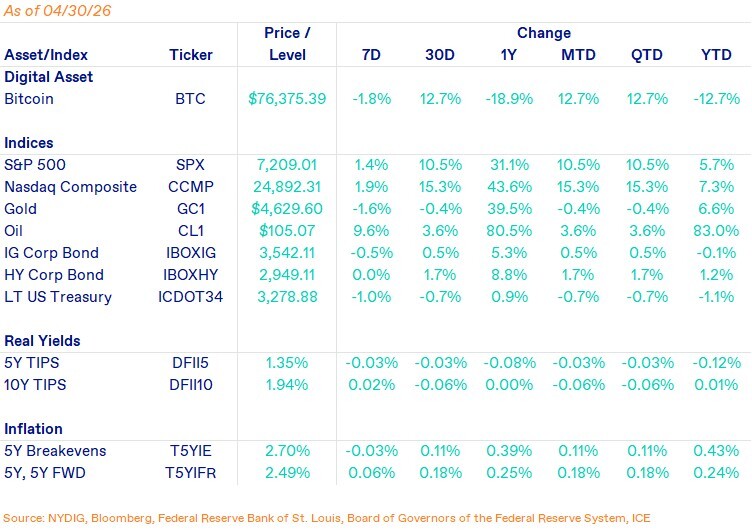
Bitcoin declined 1.8% over the past week after failing to sustain a breakout above the $80K level, with price action transitioning into a consolidation range following the rejection. The inability to clear $80K reflects near-term supply at higher levels, while trading activity softened during the Bitcoin conference window, consistent with prior years where liquidity and market focus temporarily decline, before stabilizing into the latter part of the week.
Relative performance lagged equities, with the S&P 500 up 1.4% and the Nasdaq up 1.9% over the same period, indicating incremental capital rotated toward traditional risk assets.
Macro developments introduced incremental policy uncertainty, as the Senate Banking Committee advanced Kevin Warsh’s nomination for Fed Chair while Jay Powell confirmed he will remain on the Board as a governor after his Chair term ends in May 2026. This decision represents a break from modern precedent, during which departing Chairs have exited the Board entirely, with the last comparable instance occurring in 1948. Powell is staying on as a Fed governor, citing unprecedented legal attacks on the Fed's independence and unresolved questions around the $2.5B HQ renovation review, with his departure date undefined
Finally, the coordinated DeFi backstop for Kelp DAO has reached 50,450 ETH in confirmed commitments, with total pledges rising to 137,615 ETH, including pending votes, compared to 116,500 rsETH stolen in the exploit. The scale of pledged capital now exceeds the loss on a gross basis, contingent on governance approvals, signaling strong industry alignment to contain systemic spillover.
Market pricing has responded accordingly, with the rsETH/ETH ratio recovering to 1.05 from a post-exploit low of 0.87, versus 1.07 pre-incident, indicating a meaningful restoration of confidence as recapitalization efforts gained visibility. The remaining ~2% discount to pre-hack levels implies residual risk tied to the execution of pending votes and final loss socialization outcomes.
Important News This Week
Investing:
Paul Tudor Jones Interview Calling Bitcoin "The Best Inflation Hedge" - X
Institutional Demand to Drive Bitcoin Market Cap to $16 trillion by 2030: Ark Invest - CoinDesk
Regulation and Taxation:
SEC, CFTC Chiefs Signal ‘New Day’ for U.S. Onshore Crypto, Tokenization and Future‑Proof Rules - Bitcoin Magazine
Celsius Founder Alex Mashinsky Banned From Crypto Industry in $10 Million FTC Settlement - Decrypt
Companies:
Tether Investments Proposes Merger Plans at Twenty-One Capital to Accelerate its Strategic Direction - Tether
Tether Posts $1.04 Billion Q1 Profit, Reaches $8.23 Billion Reserve Buffer - CoinDesk
MARA Holdings to Buy Long Ridge Energy in $1.5 Billion AI Data Center Push - CoinDesk
Trump Family Crypto Project Quietly Sold as Holders Got Stuck - Bloomberg
Upcoming Events
May 5 - Consensus Conference
May 12 - CPI release
May 29 - CME expiry